
THE YOUNG EX-PAT AS ‘SIDI MARABOUT’
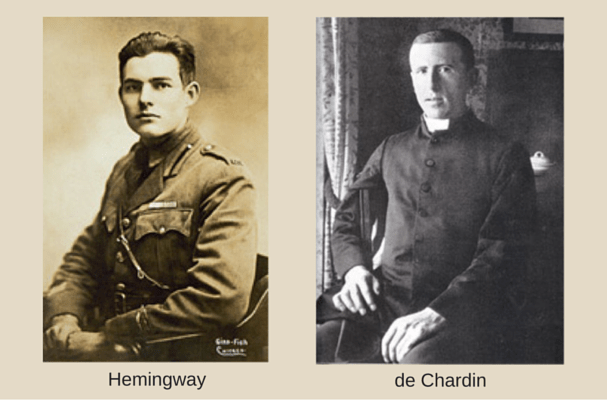
Sidi Marabout is a Muslim designation to describe one who is believed to be “closely bound to God”. The place is Morocco, World War I the situation. A regiment of Moroccan Sharpshooters recall a young European who labored in their midst as stretcher bearer, tirelessly removing the dead and consoling the dying from the horrors of desert warfare. The ex-pat was a Jesuit priest from France. The world would come to appreciate him, not for his work in Morocco, but as the great hearted Pierre Teilhard de Chardin. He would decline numerous field promotions to remain with his newly allied Muslim combatants amidst frontline uncertainties. He would write.
Many miles to the North, at nearly the same hour across the Mediterranean Sea–another young ex-pat enters someone else’s battlefield as volunteer, this time, an American. Ernest Hemingway, not quite 19 years in 1918, would drive an ambulance in WW I Italy until his battlefield injuries forced him to the sidelines. Sidi Marabout? He, too, would write.
“Whatever I had to do men had always done. If they had done it then I could do it too and the best thing was not to worry about it.” From “Men At War”, 1942, by Ernest Hemingway
We proceed, in this inaugural Numinosa-of-the-Lakes post, ex-pats and volunteers all, to explore together a body of work as literature, imagery, verse, paradox, and platitude as presented by the Editors. Ahead, we wander as Candide, or Gulliver, as Chuck Noland (played by Tom Hanks in “Cast Away”), Forrest Gump—a pre-Socratic wise person or someone capable of channeling Bukowski. It is a gestalt of all the parts that calls to us, a gestalt allowing us at a deep soul level to sense the holy in the unremarkable (a box of chocolates), the lightless dim (‘Love is a dog from hell’) or the empty horizon of our confusion (a volleyball named Wilson). It is the prayer of the marooned.
To be ex-patria is to leave the community of one’s origin, its safety as homeland and its companionship. Like a shooting star entering Earth’s atmosphere after a long weightless voyage, each of us has intercepted Time (as history) to finish the transit of our own individuation, weighted and alone. When our Time in history is concluded, our tongue, teeth and lips are quiet, and the stardust that held us rests, a homecoming of the marooned ensues so we may be assured the story cannot end badly. The stretcher bearer clamors mightily in our direction, the ambulance driver sounds the alarm to signal the rescue. Was it even possible to remain unknown to the angels?
Would it be grand were we led to co-appreciate the arc of this journey as spectacular metaphysical adventure? Let it be so.
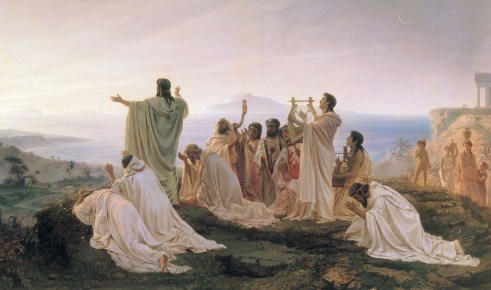
Pythagoreans Celebrate Sunrise by Fyodor Bronnikov
Can we hear Hemingway to de Chardin, saying,“Whatever we have to do, people have already done.”
“[Indeed, Ernest],” replies de Chardin. “Together we suffer, together exist, and forever will recreate each other.”
Welcome to Numinosa-of-the-Lakes
 numinosa.org